




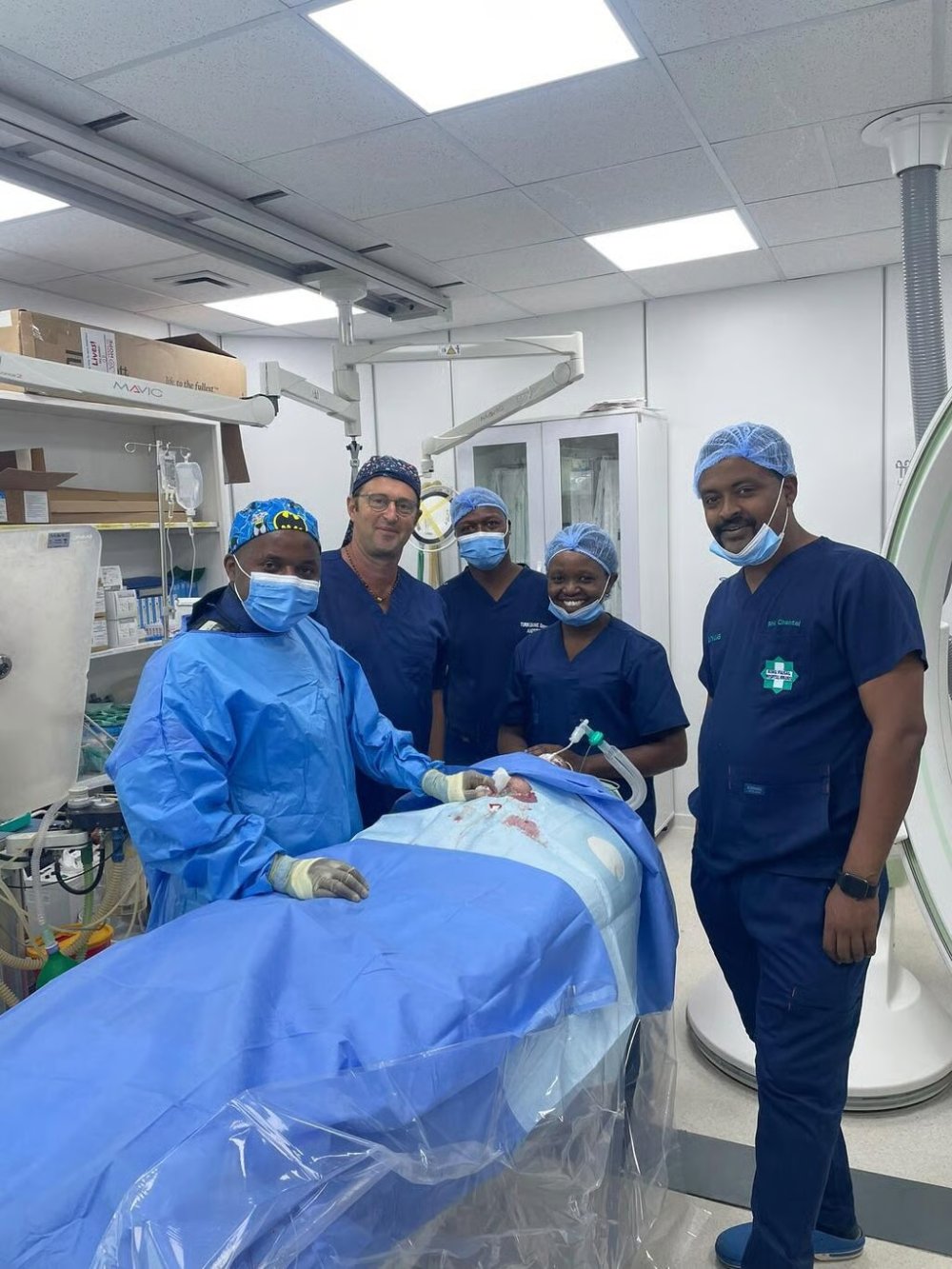
An extraordinary medical procedure has saved the life of an 11-day-old baby boy at Faisal Hospital in Kigali, Rwanda, after a leading pediatric heart specialist travelled from Israel to support a local medical team in performing a complex intervention.
The procedure was carried out on 22 July 2026 by a team led by Rwandan Cardiologist Dr. Gerard Misago, in collaboration with Israeli Pediatric Cardiologist Dr. Sagi Assa and Rwandan pediatric anesthetist Dr. Christine Niyibogora.
Dr. Assa, who heads the pediatric interventional cardiology unit at Wolfson Medical Center in Israel, travelled more than 4,000 kilometers to Rwanda after being invited by Dr. Misago, his former medical student in Israel. His visit was aimed at supporting the development of advanced pediatric heart care services in Rwanda.
After successfully completing the procedure, Dr. Assa returned to Israel on the same day.
A life-threatening heart condition
The baby, named Angel, was born with a serious heart condition known as critical pulmonary valve stenosis. The condition occurs when the pulmonary valve, which controls blood flow from the heart to the lungs, becomes severely narrowed, preventing enough blood from reaching the lungs.
Without urgent treatment, the condition can lead to dangerously low oxygen levels in the body and heart failure.
Angel was born as one of twins in a rural Rwandan family. Before reaching Faisal Hospital in Kigali, he had been transferred through four different hospitals across the country. When he arrived at Faisal Hospital, doctors determined that his condition was critical and required immediate specialized care.
Because Angel weighed only 2.6 kilograms and was just 11 days old, the medical team considered the procedure highly challenging. Dr. Misago contacted Dr. Assa because of the risks involved and the need to combine their expertise to increase the chances of success.
Advanced treatment without open-heart surgery
The doctors performed a procedure known as balloon pulmonary valvuloplasty. This minimally invasive technique involves inserting a small catheter with a balloon at its tip through a blood vessel and guiding it to the heart. Once positioned, the balloon is inflated to open the narrowed valve, allowing blood to flow more freely to the lungs.
Unlike traditional open-heart surgery, the procedure does not require opening the baby’s chest. However, it requires exceptional precision because the catheter must pass through extremely small blood vessels in a newborn’s body.
A small mistake during the procedure could have resulted in serious complications.
The operation was performed by Dr. Gerard Misago together with Dr. Sagi Assa and Dr. Christine Niyibogora, a Rwandan specialist in pediatric cardiac anesthesia who also trained in Israel through the Save a Child’s Heart programme.
A successful outcome for baby Angel
Following the procedure, Angel’s pulmonary valve was successfully opened. Within hours, his condition began improving. He was removed from breathing support and was reunited with his mother, allowing her to breastfeed him.
The baby is currently being monitored in the Intensive Care Unit (ICU) as doctors continue to follow his recovery.
“The goal of a teacher is to help a student become independent”
Dr. Assa said his greatest satisfaction was not only being able to perform the procedure, but also witnessing the growing ability of Rwandan doctors to treat complex heart conditions in children.
“The role of a teacher is to help a student become independent, not to make them permanently dependent. I came to support, but the person leading the procedure was the one in charge,” he said.
He added that seeing Dr. Misago and his team confidently manage such a complex case demonstrated that Rwanda is developing the capacity to provide advanced cardiac care for children.
The successful procedure comes only a few months after Dr. Misago returned to Rwanda following three years of specialized training in Israel, marking another important step in strengthening pediatric heart services in the country.